
Published by 动画学术趴 (an industry-focused Chinese outlet covering animation trends, production, and market dynamics), this article analyzes how the original Chinese animated series 《伍六七》 (Scissor Seven) became a rare example of sustainable overseas success.
Editor’s note: The full article below was originally published by 动画学术趴 (Original article). AHAVERSE provides this faithful English translation for readers and media partners.

Editor / Qingzhou
Layout / Eis
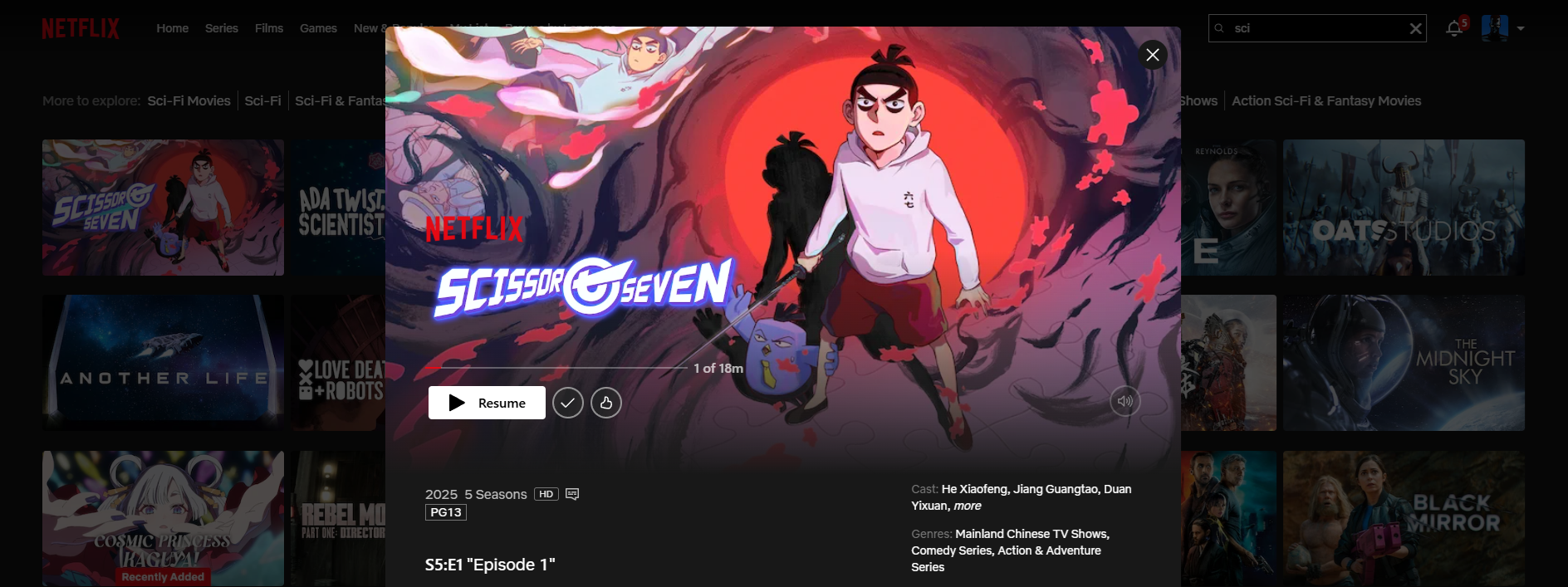
When an original Chinese animated series updates to its fifth season on Netflix, and consecutively earns the “Netflix Original” label, this has already gone beyond a simple overseas licensing deal. It has become the only sample for observing how China’s original animation can achieve sustainable operations in the international mainstream market—and build a global IP.
From the first season going live in 2020 to today, Scissor Seven has covered 190 countries and regions worldwide, with 29 subtitle options and dubbing in 5 languages. While overseas fans cheer for the launch of Season 5, we should pay even more attention to the systematic path for Chinese original animation’s overseas expansion that it sketches out behind the scenes.
01 Going overseas is not accidental, but inevitable
Scissor Seven’s global distribution strategy was set as early as the initial stage of IP incubation. When the producer, AHA Entertainment, first evaluated its early demo, it concluded the project had global potential and proactively pushed it onto international stages such as the Annecy International Animation Film Festival in France. This successful debut not only made it the only Chinese work selected for that year’s main competition section, but also directly facilitated an early opportunity to cooperate with Netflix. From there, it opened a path anchored to the global market right from the starting point.
This strategy is directly reflected on two levels: in terms of channels, it chose to launch globally as a “Netflix Original,” which not only means smooth distribution, but also means the platform regards it as part of its global content matrix, providing resource support and promotion. Netflix’s head of animation, John Derderian, once commented that it “has the opportunity to resonate with animation fans around the world.” In execution, it treats high-quality multilingual dubbing as a standard configuration. Scissor Seven produced four foreign-language dubs—English, French, Spanish, and Japanese—thereby covering audiences across Asia, Europe, the Americas, Africa, and Oceania. This localized dubbing model allowed it to break away from “Chinese-language circle” dissemination that relies on subtitles, directly targeting a broader audience of non-native Chinese speakers.
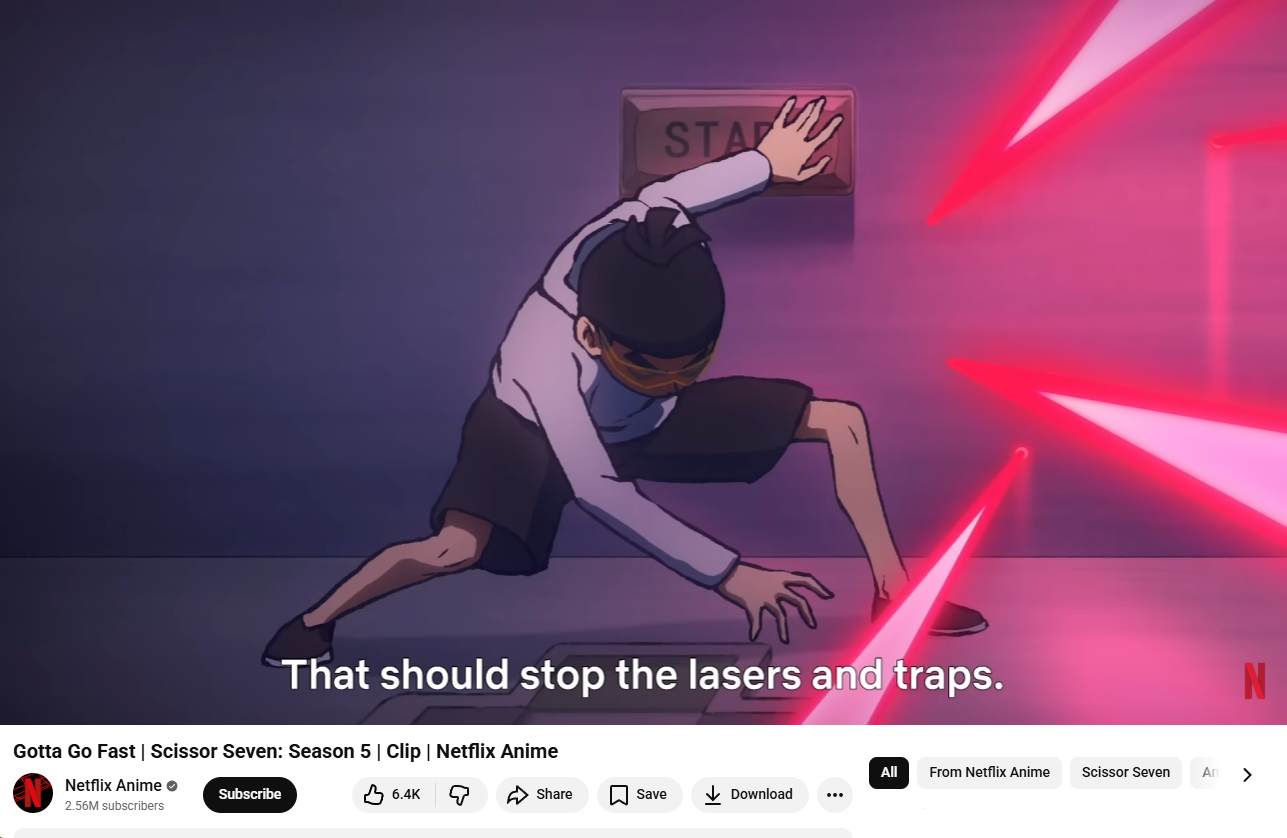
Netflix officially announced on YouTube the global launch of Scissor Seven Season 5
This strategic choice, in essence, uses higher initial costs and more complex collaboration processes in exchange for a purer starting point as a “globalized IP.” Up to this point, it has become the only domestic animated IP to achieve five consecutive seasons of global simultaneous distribution under the “Netflix Original” brand—proving the sustainability of its strategy.
02 A good story has no borders
Whether facing domestic or overseas audiences, the first standard for testing a work’s vitality is always: is this a good story that moves people? Scissor Seven did not rely on a Chinese mythology system; instead, it built an original story about the growth of a modern “little person.” This setup naturally lowers the comprehension barrier for global audiences.
More crucially, it quickly guides viewers toward an emotional core shared by humanity. In the animation, Wu Liuqi fights again and again to protect the people around him and the small island where he lives. When viewers’ emotions are ignited by Wu Liuqi’s battling figure, Scissor Seven truly enters their hearts. “I want to protect the people who matter”—this is an emotional resonance that crosses language, culture, and geographic divides.
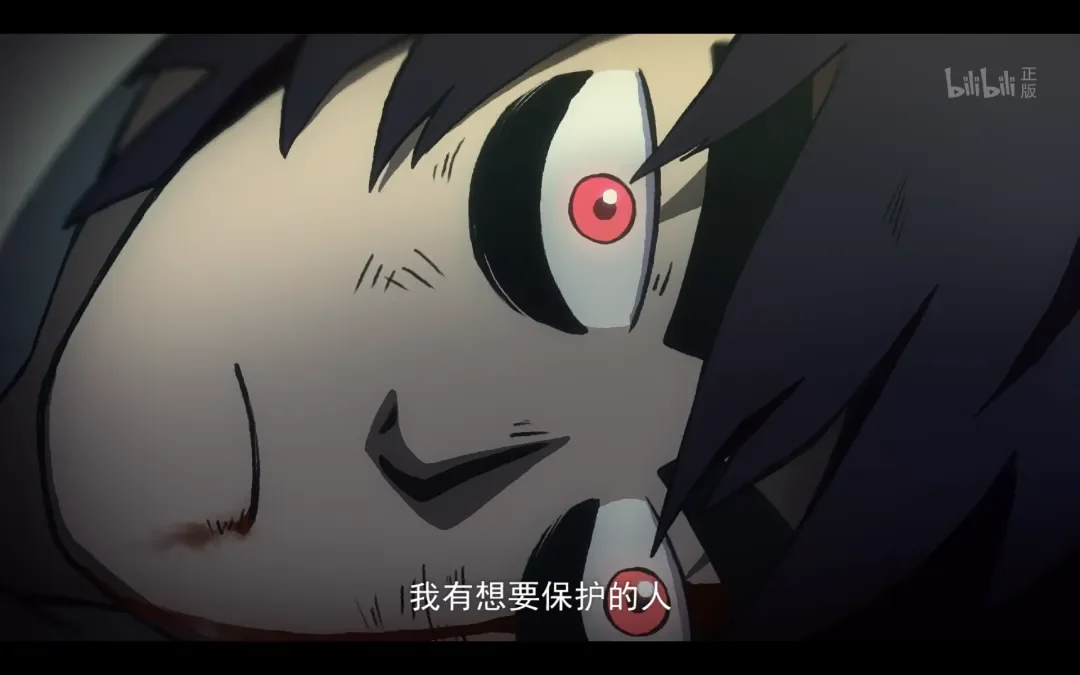
And the protagonist’s spiritual core—“be brave to be yourself”—further amplifies this resonance. Wu Liuqi is not a hero by nature; he is confused and imperfect. In the process of searching for himself, he learns to accept flaws and faces challenges with humor and optimism. Imperfect Aqi is like imperfect you and me; every viewer can see themselves in Wu Liuqi. Aqi was not born as the number-one under heaven; in the process of seeking himself, he gradually accepts his own shortcomings, facing challenges with a humorous, open-minded, and optimistic attitude. Through his actions, Wu Liuqi conveys a plain value: “Imperfect is imperfect—may you be brave to be yourself!”
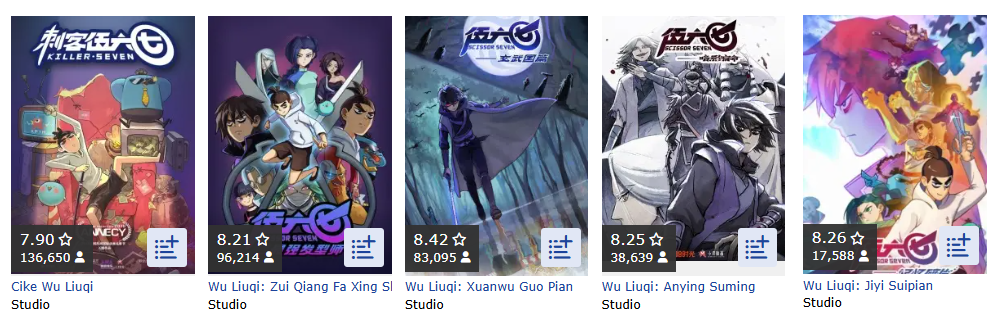
The first five seasons of Scissor Seven have continuously maintained high scores on the overseas rating site MyAnimeList
Exploring individual value and inner growth is the universal emotion carried by this original story, and also a topic shared by the modern world. As producer Aiken Zou said, she believes the universal values in the work can naturally reach global audiences.
03 Cross-culture Humor: Even Lingnan slippers can crack up Western audiences
Director He Xiaofeng and his team are deeply influenced by Lingnan culture. Therefore, Scissor Seven also reveals a strong Guangdong regional flavor, filled with life-textured details—reclusive masters wearing slippers, beef offal stalls on bustling streets, vivid Cantonese-Mandarin dialect—together building a distinctive, self-consistent, and vibrant world.

Slippers from the sky
At the beginning of its overseas launch, Netflix’s head of animation John Derderian stated: “We really love the Chinese culture and unique elements presented in Scissor Seven. What we want is exactly this kind of truly local content. We believe it will resonate with and be loved by animation fans around the world.”
But how can an animation full of the smoky “Cantonese street food stall” vibe hit the funny bone of North America and even global audiences? Scissor Seven’s practice reveals a path: successful cultural communication is not “self-dilution,” but rather clever “cultural translation.” Its strategy is to turn distinct regional characteristics into an “exclusive seasoning” that enhances charm and recognizability. This is precisely the deeper meaning behind choosing the Chinese-descended stand-up comedian Ronny Chieng as the lead voice actor for the English dub. He is not merely a dubbing actor; he also plays the role of a “cultural-joke translator.”

You might not know him, but you may have heard his stand-up
In a previous interview, Scissor Seven’s producer and AHA Entertainment founder Zou Shasha introduced: “Ronny Chieng is a very popular comedian in North America and has appeared in multiple Hollywood films. As a Chinese descendant, he is fluent in both Chinese and English. During dubbing, he can even spot translation errors in the script, and he is also very familiar with the various jokes and language puns in the original version, preserving the original flavor of Scissor Seven to the greatest extent.” (Previous article: Scissor Seven is becoming a new calling card for Chinese animation overseas.) Thus, the original Wu Liuqi with a Cantonese-Mandarin accent, through contextual conversion, spoke English with an East Asian “bonus,” successfully retaining the character’s traits.
For overseas audiences, the Cantonese humor and language puns in the original became appropriately expressed in an English context; the streetwise wit and character temperament did not get lost in translation, but survived in vivid form. This fresh and interesting “exotic experience” constitutes a strong aesthetic attraction. Scissor Seven’s overseas story proves that cultural difference is not necessarily a barrier—after creative translation, it can fully become the most infectious memory point of a work. Local everyday “smoky” flavor thus becomes a uniquely tasty seasoning that connects audiences worldwide.
04 Community building: cultivating “self-growing power” from thousands of miles away
If content and distribution channels are the hardware for going overseas, then long-term overseas fan operations are the software system that lets an IP “survive” and “catch fire” abroad. The core of Scissor Seven’s overseas operations lies in building a fan ecosystem that encourages participation and can even grow on its own.
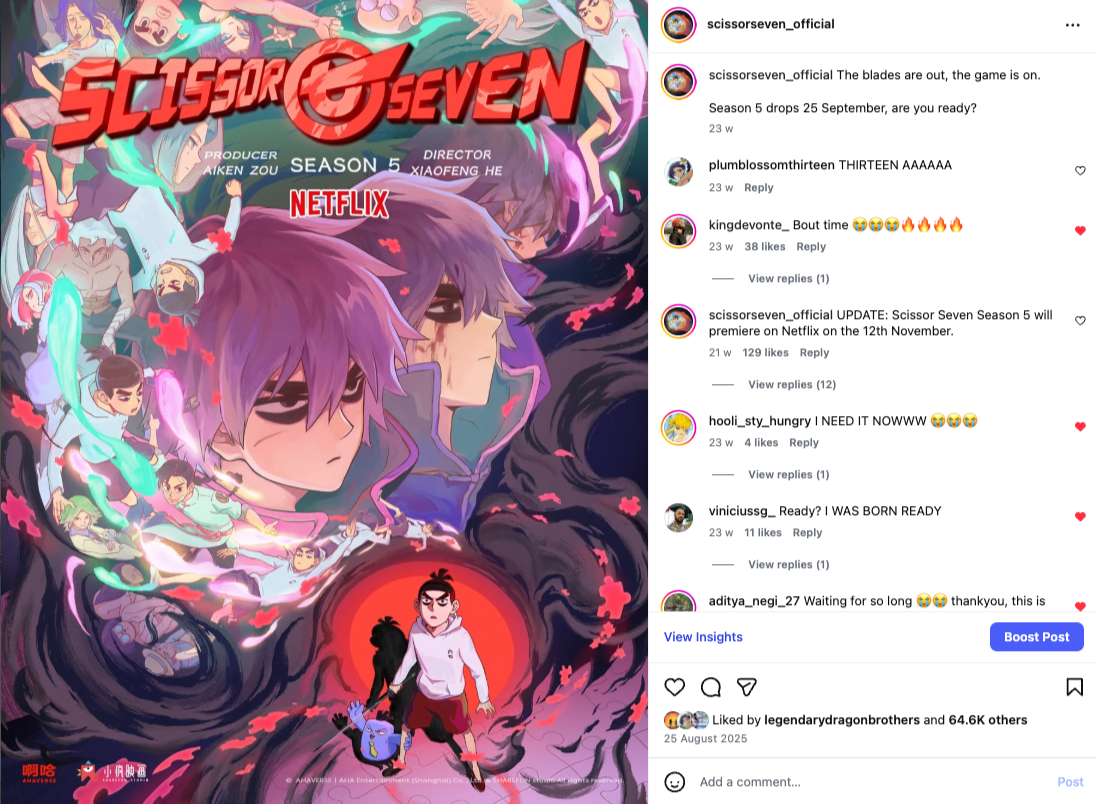
Scissor Seven’s official Instagram celebrates Season 5’s overseas premiere with fans
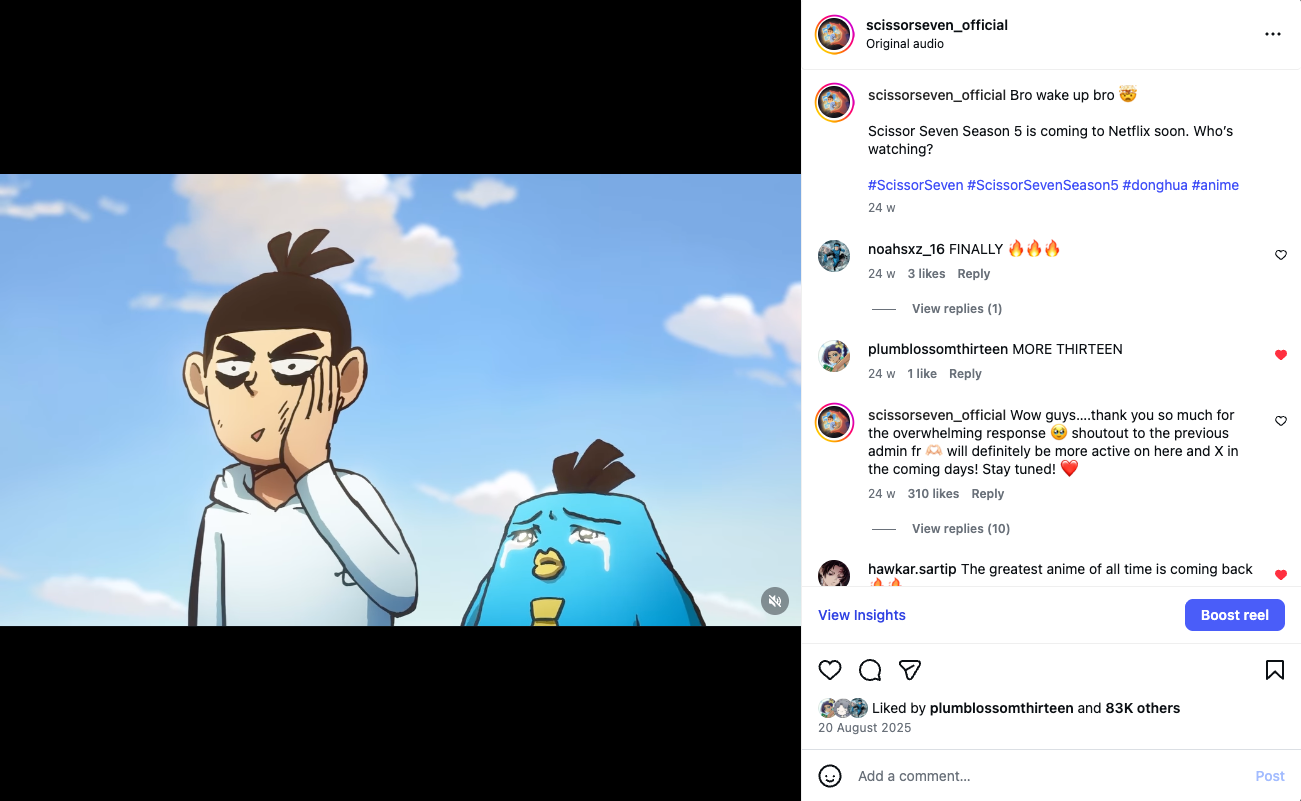
Scissor Seven’s official account reminds fans of Season 5’s overseas premiere
Scissor Seven’s official overseas social media accounts have long surpassed being simple information bulletin boards. Through high-frequency fan interaction, they continuously maintain intimacy and a sense of being “online,” and by setting up “Fanart Friday,” they encourage fan creations. The essence of this strategy is to convert fans’ vigorous secondary-creation enthusiasm into a native content source that sustains the IP’s heat, forming a sustainable co-creation loop between official and fans—so the IP stays fresh even during the gaps while waiting for new season updates.
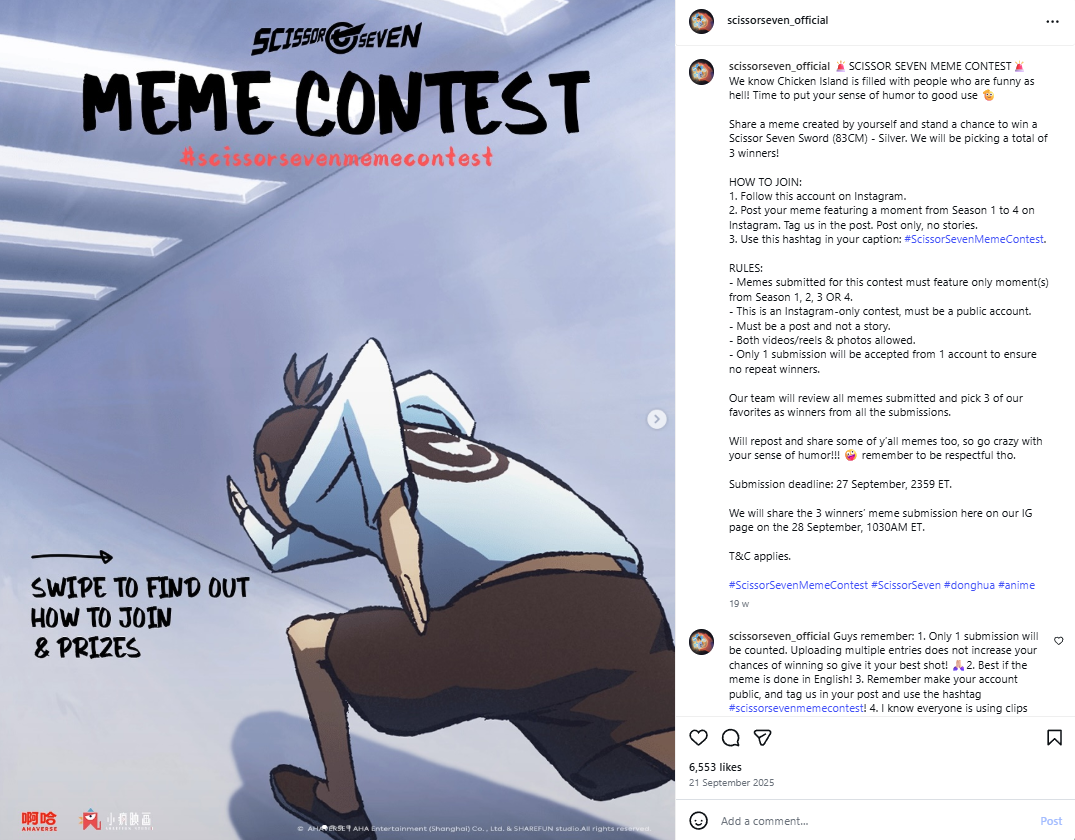
Before Season 5 launched, Scissor Seven’s official account initiated a cross-platform meme contest
At the same time, coordinated promotion with Netflix, voice actors, and overseas key opinion leaders (KOLs), as well as a long-term communication mechanism with core community managers and opinion leaders in Discord communities, enables first-hand information about Scissor Seven to spread autonomously among fan groups at the earliest moment through different touchpoints.
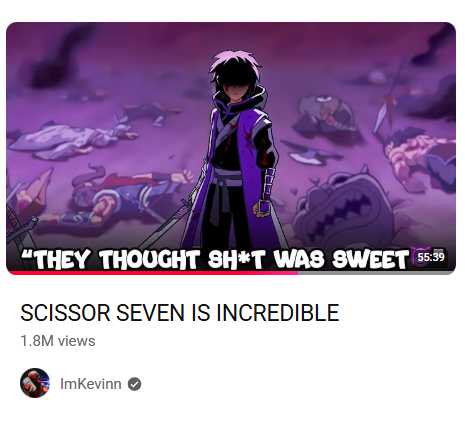
Overseas content creators share Scissor Seven-related videos on YouTube
Ultimately, a community driven by emotional connection needs a physical carrier to crystallize a sense of belonging. Facing the difficulty for overseas fans to purchase “goods” (merch/derivatives), the launch of an official overseas shopping website—selecting premium merch to list and making it convenient for overseas customers to buy—uses merch to enhance overseas viewers’ sense of companionship and belonging to the IP, thereby strengthening fan stickiness and linking more global users through content and products. This is also a key link for Scissor Seven to transform online emotional identification into an offline sense of companionship.
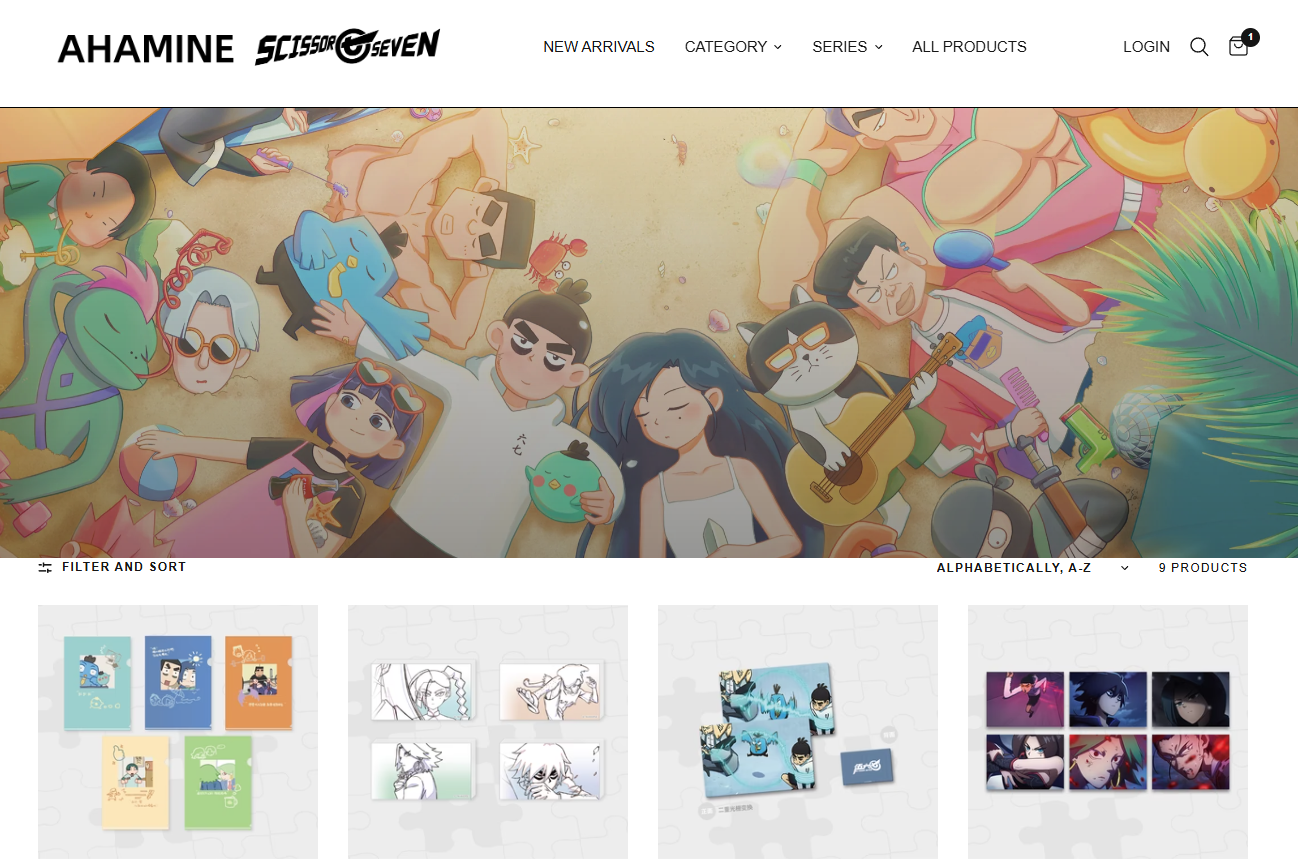
Scissor Seven overseas e-commerce site
05 Chinese animation going overseas: the momentum is just beginning
Scissor Seven’s path reveals a rare “systematic overseas expansion” capability combination: it replaces opportunism with strategic patience, anchoring global distribution from the early stage of IP incubation; it breaks cultural barriers with universal emotions, firmly believing love and inclusion can dissolve hatred and prejudice; it crosses aesthetic divides with cultural translation wisdom, turning regional characteristics into global attraction; and it cultivates the IP’s self-generated vitality thousands of miles away through community co-building. This combination punch makes it go beyond the simple scope of “content going overseas” and initially step into the deep-water zone of “IP ecosystem going overseas.” This is exactly what its producers believe—good content must be matched with a good operations system in order to cross mountains and seas and take root and grow.
However, by comparison, the general reality of domestic animation going overseas is closer to “point-like breakthroughs.” On the most representative overseas animation communities and rating sites (such as MyAnimeList), absolute dominance still belongs to Japanese animation. This is not simply a matter of taste preference, but a solid barrier built by decades of industrialized production and systematic output. Chinese animation occasionally has good works on the list, but cases like Scissor Seven that can form sustained seasonal influence and inspire long-term overseas community creation enthusiasm are extremely rare.
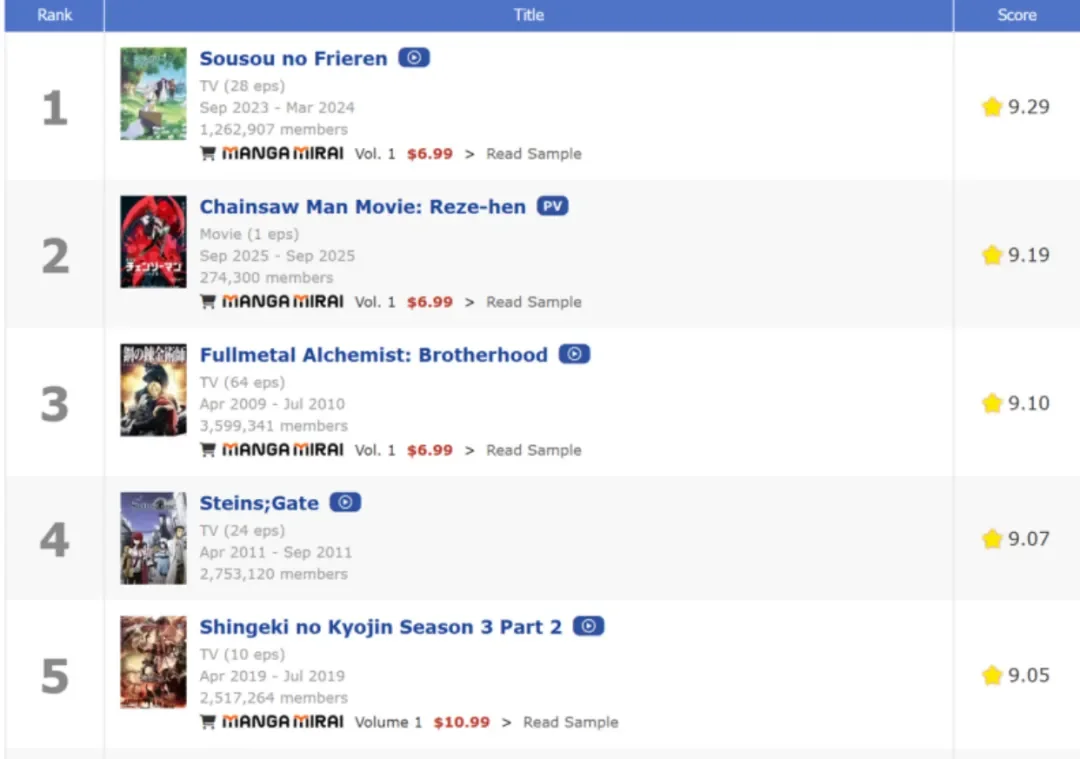
The top five of MAL’s overall ranking are all Japanese animation
Scissor Seven’s overseas story is far from the time to write an ending. Its significance is not to provide a template that can be simply copied, but rather, like a ship that first sails into the deep sea, to prove the reachability of the direction. It marks the key navigational beacons needed from “work going overseas” to “IP going overseas,” and even future “ecosystem going overseas”: a global vision in strategy, a universal connection in narrative, translation wisdom in culture, and long-term patience in operations.

International media CBR lists 6 Chinese “Donghua” works comparable to top Japanese animation IPs
And this five-season voyage of Scissor Seven, its ultimate value has long surpassed the success of a single animation. Its more important role is as a pathfinder and validator. As a pathfinder, it was the first to pass through wind and waves, proving that the route called “systematic overseas expansion” is truly feasible. And as a validator, it brought back a clear “nautical chart.” It proves that the sails of Chinese animation can, relying on systematic power rather than a burst of accidental gale, sail into the central waters of world culture.
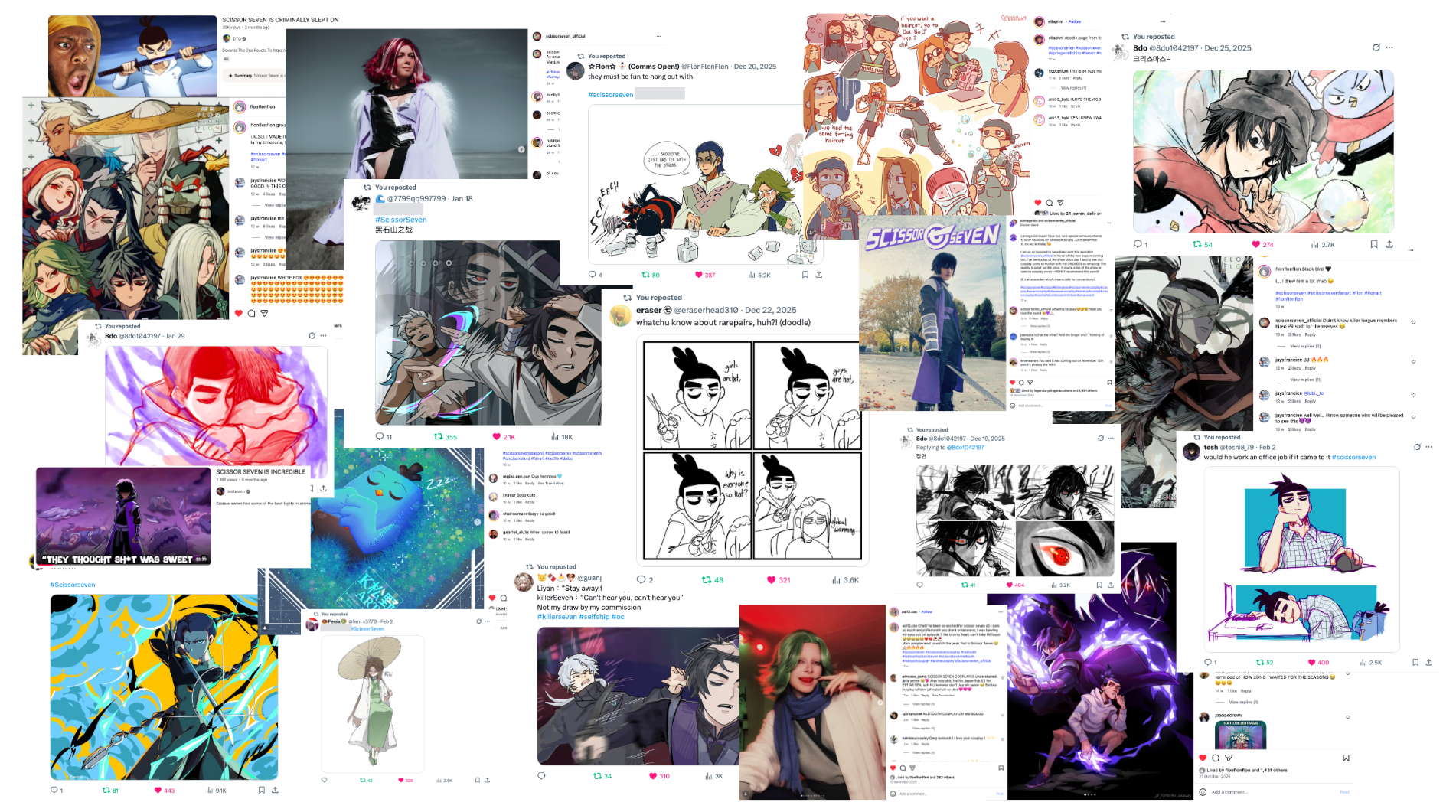
Scissor Seven and its global fans
Today, this story grown from a small island in southern China has not only reached 190 countries and regions worldwide, but also, in the form of five consecutive seasons as a “Netflix Original,” has won a place in the hearts of overseas audiences. Its route has marked one verified coordinate after another for those who come later. The grand narrative of Chinese animation going overseas will thus turn to a new question: how can the wind-and-wave journey of one ship give rise to the collective far voyage of a fleet?
Looking across the history of the global animation industry, top IPs that can cross cultures, traverse cycles, and form long-term influence all begin with original DNA. Scissor Seven’s practice also proves that Chinese animation is fully capable of getting through this classic and core IP-building path.
When in the future we look back at Scissor Seven’s story, perhaps it will be defined as a “starting point” for Chinese original animation truly moving toward globalization. Its remarkable achievement lies not only in how far it went, but also in its firm choice of the most essential, most difficult, and most infinitely possible road—using original IP to dialogue with the world. And also in that, with a solid five-season voyage, it won back for the entire industry something most precious: a confirmed “feasibility,” and an incomparably valuable confidence rooted in practice.
